Calculating concrete requirements accurately is essential for any construction project, whether you're building a driveway, patio, or foundation. Getting the measurements wrong can lead to costly overruns or, worse, insufficient concrete for your project. This comprehensive guide will teach you professional concrete calculation methods used by contractors and engineers.
Understanding Concrete Volume Calculations
Concrete is measured in cubic yards or cubic meters, and the basic formula is simple: Length × Width × Height (or Depth). However, real-world projects often involve complex shapes, slopes, and varying thicknesses that require more sophisticated calculations.
Basic Volume Formula
The fundamental formula for calculating concrete volume is:
Volume = Length × Width × Height
For example, a 10-foot by 10-foot slab that's 4 inches thick:
- Length: 10 feet
- Width: 10 feet
- Height: 4 inches = 0.33 feet
- Volume: 10 × 10 × 0.33 = 33 cubic feet
- Convert to cubic yards: 33 ÷ 27 = 1.22 cubic yards
Common Concrete Project Calculations
Different types of concrete projects require different calculation approaches. Here are the most common scenarios you'll encounter.
Driveway Calculations
Driveways typically require 4-6 inches of concrete thickness. For a standard two-car driveway (20 feet wide by 20 feet long):
- Length: 20 feet
- Width: 20 feet
- Thickness: 5 inches (0.42 feet)
- Volume: 20 × 20 × 0.42 = 168 cubic feet
- Cubic yards: 168 ÷ 27 = 6.22 cubic yards
Foundation Slab Calculations
Foundation slabs require more concrete due to their structural importance. A typical foundation might be 30 feet by 40 feet with a 6-inch thickness:
- Length: 30 feet
- Width: 40 feet
- Thickness: 6 inches (0.5 feet)
- Volume: 30 × 40 × 0.5 = 600 cubic feet
- Cubic yards: 600 ÷ 27 = 22.22 cubic yards
Patio and Walkway Calculations
Patios and walkways typically use 3-4 inches of concrete. For a 12-foot by 16-foot patio with 4-inch thickness:
- Length: 12 feet
- Width: 16 feet
- Thickness: 4 inches (0.33 feet)
- Volume: 12 × 16 × 0.33 = 63.36 cubic feet
- Cubic yards: 63.36 ÷ 27 = 2.35 cubic yards
Advanced Calculation Techniques
Real-world projects often involve irregular shapes, slopes, and multiple sections that require more sophisticated calculations.
Calculating for Sloped Surfaces
When dealing with sloped surfaces, you need to calculate the average thickness. For a surface that slopes from 4 inches to 6 inches:
- Average thickness = (4 + 6) ÷ 2 = 5 inches
- Use this average thickness in your volume calculations
Multiple Section Calculations
For projects with different sections (like a driveway with a parking area), calculate each section separately and add them together:
- Section 1: 20' × 10' × 0.33' = 66 cubic feet
- Section 2: 15' × 8' × 0.33' = 39.6 cubic feet
- Total: 66 + 39.6 = 105.6 cubic feet
- Cubic yards: 105.6 ÷ 27 = 3.91 cubic yards
Accounting for Waste and Overages
Always add 5-10% to your calculations to account for waste, spillage, and minor variations in thickness:
- Base calculation: 3.91 cubic yards
- Add 10% waste: 3.91 × 1.10 = 4.30 cubic yards
- Round up to nearest quarter yard: 4.5 cubic yards
Concrete Mix Ratios and Materials
Understanding concrete mix ratios helps you order the right amount of materials and ensures proper strength for your project.
Common Mix Ratios
- 1:2:3 Mix: 1 part cement, 2 parts sand, 3 parts gravel
- 1:3:5 Mix: 1 part cement, 3 parts sand, 5 parts gravel
- Ready-Mix: Pre-mixed concrete delivered by truck
Calculating Materials for 1 Cubic Yard
For a standard 1:2:3 mix, you'll need approximately:
- Cement: 6 bags (94 lbs each)
- Sand: 0.5 cubic yards
- Gravel: 0.75 cubic yards
- Water: 30-35 gallons
Cost Estimation and Budgeting
Accurate cost estimation is crucial for project planning and budgeting. Concrete costs vary by region, but here are general guidelines.
Cost Factors
- Concrete Price: $100-150 per cubic yard
- Delivery Fees: $50-100 per truckload
- Labor Costs: $3-5 per square foot
- Reinforcement: $0.50-1.00 per square foot
- Finishing: $2-4 per square foot
Sample Cost Calculation
For a 20' × 20' driveway (400 square feet, 4.5 cubic yards):
- Concrete: 4.5 × $125 = $562.50
- Delivery: $75
- Labor: 400 × $4 = $1,600
- Reinforcement: 400 × $0.75 = $300
- Finishing: 400 × $3 = $1,200
- Total: $3,737.50
How Concrete Calculator Pro Simplifies Calculations
While manual calculations are important to understand, modern technology can significantly streamline the process and reduce errors. Concrete Calculator Pro provides professional-grade calculation tools that handle complex scenarios automatically.
Automated Volume Calculations
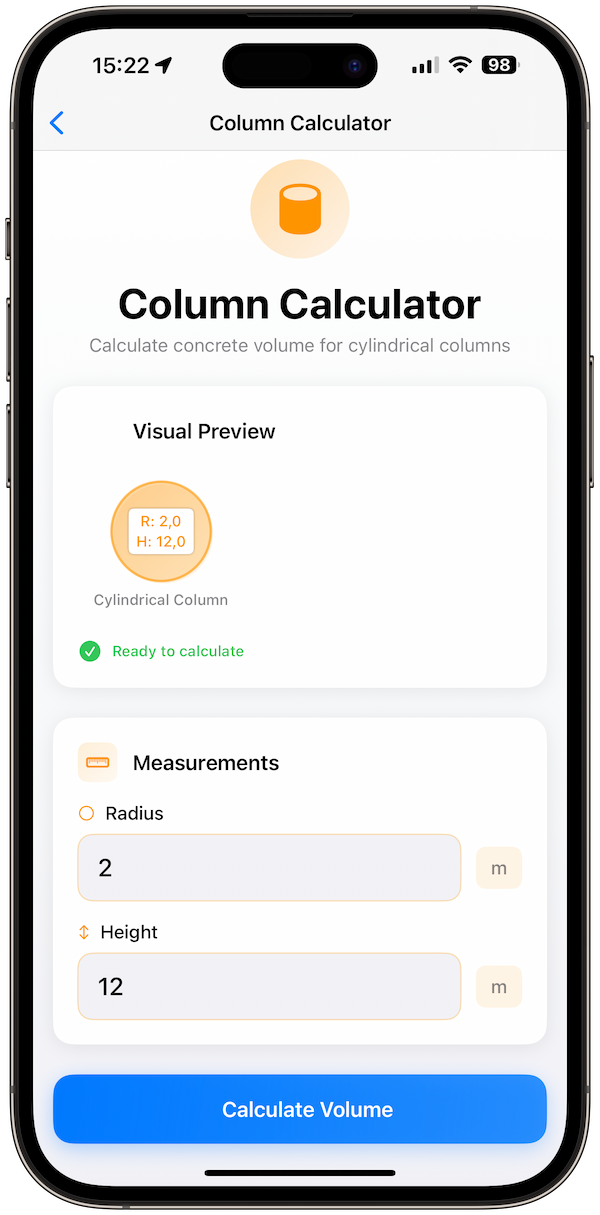
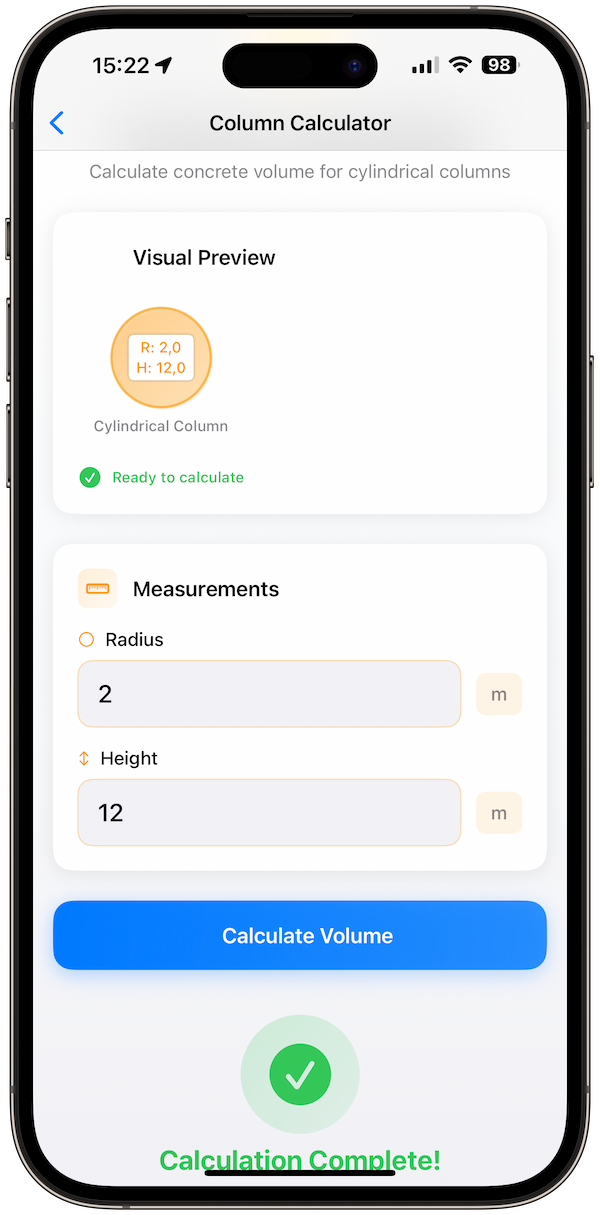
Concrete Calculator Pro automatically calculates volumes for various shapes including rectangles, circles, triangles, and irregular polygons. Simply input your dimensions and the app handles the complex mathematics.
Material Estimation
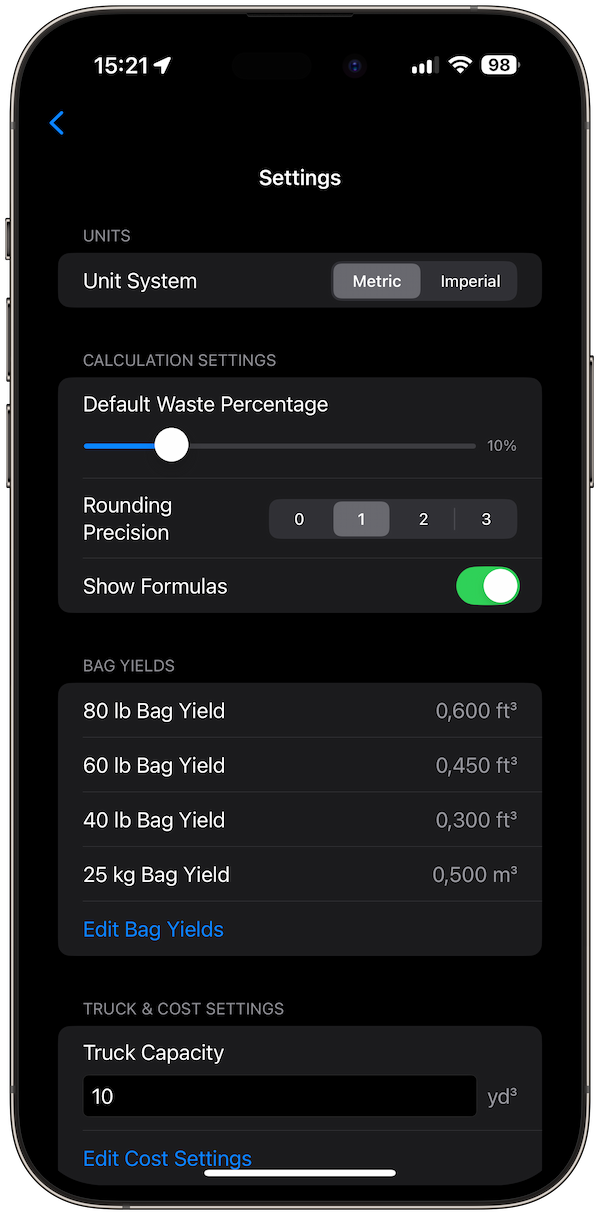
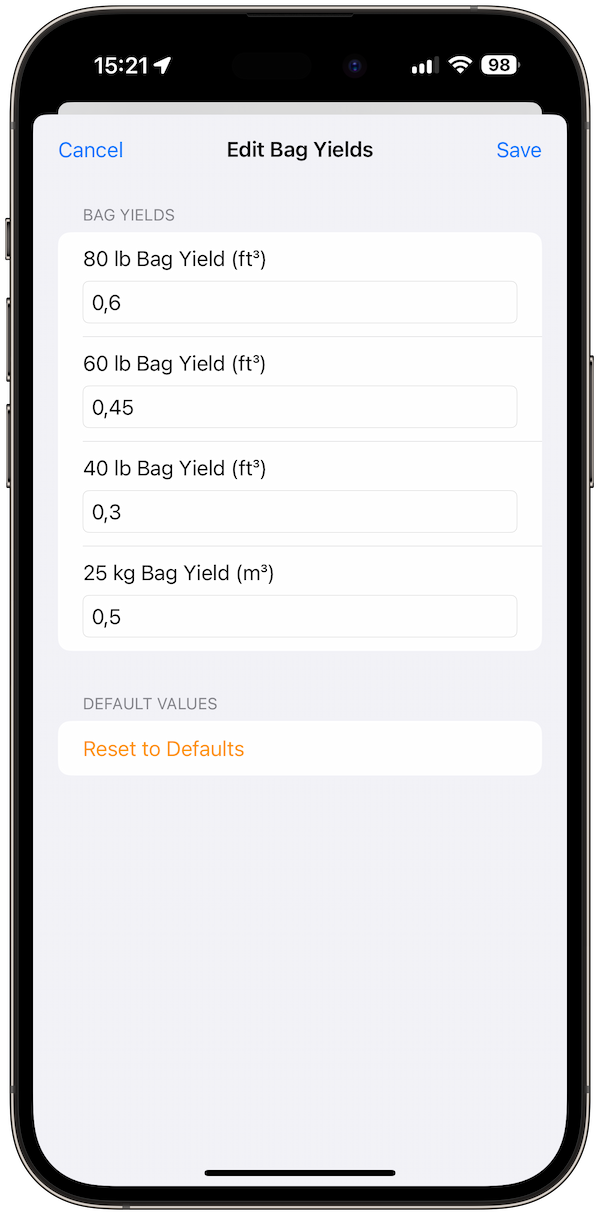
The app provides detailed material breakdowns including cement, sand, gravel, and water requirements based on your chosen mix ratio and project specifications.
Cost Analysis
Get instant cost estimates based on current material prices in your area, including delivery fees, labor costs, and finishing expenses.
Multiple Project Management
Save and manage multiple projects, compare different scenarios, and generate professional estimates for clients or contractors.
Common Calculation Mistakes to Avoid
Even experienced contractors make calculation errors. Here are the most common mistakes and how to avoid them.
Unit Conversion Errors
- Always convert all measurements to the same units
- Remember: 1 cubic yard = 27 cubic feet
- Double-check inch-to-foot conversions
Forgetting Waste Factors
- Always add 5-10% for waste and overages
- Account for spillage during pouring
- Consider minor thickness variations
Ignoring Site Conditions
- Factor in access limitations
- Consider weather delays
- Account for site preparation needs
Professional Tips for Accurate Calculations
Professional contractors use several techniques to ensure accurate concrete calculations and successful projects.
Site Surveying
- Measure multiple times for accuracy
- Check for slopes and irregularities
- Account for existing structures
- Verify measurements with a second person
Planning and Preparation
- Create detailed project drawings
- Mark all dimensions clearly
- Consider access for concrete trucks
- Plan for curing time and weather
Quality Control
- Order slightly more concrete than calculated
- Have backup plans for excess concrete
- Monitor concrete quality during delivery
- Keep detailed records for future reference
Conclusion
Accurate concrete calculations are essential for successful construction projects. By understanding the basic formulas, accounting for real-world factors, and using modern tools like Concrete Calculator Pro, you can ensure your projects are properly planned and executed.
Remember, it's always better to order slightly more concrete than needed rather than running short during a critical pour. The small additional cost of extra concrete is far less expensive than the delays and complications of running short.