You buy a new expensive telescope. You take it out on a clear Tuesday night, and Jupiter looks like a blurry, boiling mess. You assume the telescope is broken.
Wednesday night, you take it out again. Same telescope, same eyepiece. Jupiter is crisp, sharp, and showing detailed cloud bands.
What changed? It wasn't the gear. It was the Sky Quality. In astronomy, the atmosphere is the final lens element, and it is the most important one. To be a successful observer, you need to understand the three pillars of sky quality: Bortle Scale, Seeing, and Transparency.
1. The Bortle Scale (Light Pollution)
This measures how dark your sky is. It ranges from Class 1 (Pitch Black) to Class 9 (Inner City).
| Class | Description | What You Can See |
|---|---|---|
| 1-2 | True Dark Site | Milky Way casts shadows. Andromeda is huge. |
| 3-4 | Rural / Suburban | Milky Way visible but washed out near horizon. |
| 5-6 | Bright Suburban | Only bright stars visible. Andromeda is faint fuzz. |
| 7-9 | City / Inner City | Planets and Moon only. No deep sky. |
2. Seeing (Turbulence)
Seeing refers to the stability of the air. Turbulent air makes stars twinkle and planets "boil."
Impact on Magnification:
- Bad Seeing: The atmosphere limits you to 100x-120x. High power looks terrible.
- Good Seeing: You can push to 250x or 300x. The image stays still.
How to Test Seeing
Look at a bright star near the zenith (straight up). If it's twinkling madly, seeing is Poor. If it's steady like a planet, seeing is Excellent.
3. Transparency (Clarity)
Transparency measures how clear the air is (dust, humidity, smoke). A night can have perfect Seeing (steady air) but poor Transparency (haze).
Impact on Targets:
- Poor Transparency: Kills deep sky objects like galaxies and nebulae. They just disappear into the muck.
- Good Transparency: The background sky is ink-black. Contrast is high. This is Galaxy hunting weather.
The App Advantage: Smart Hints
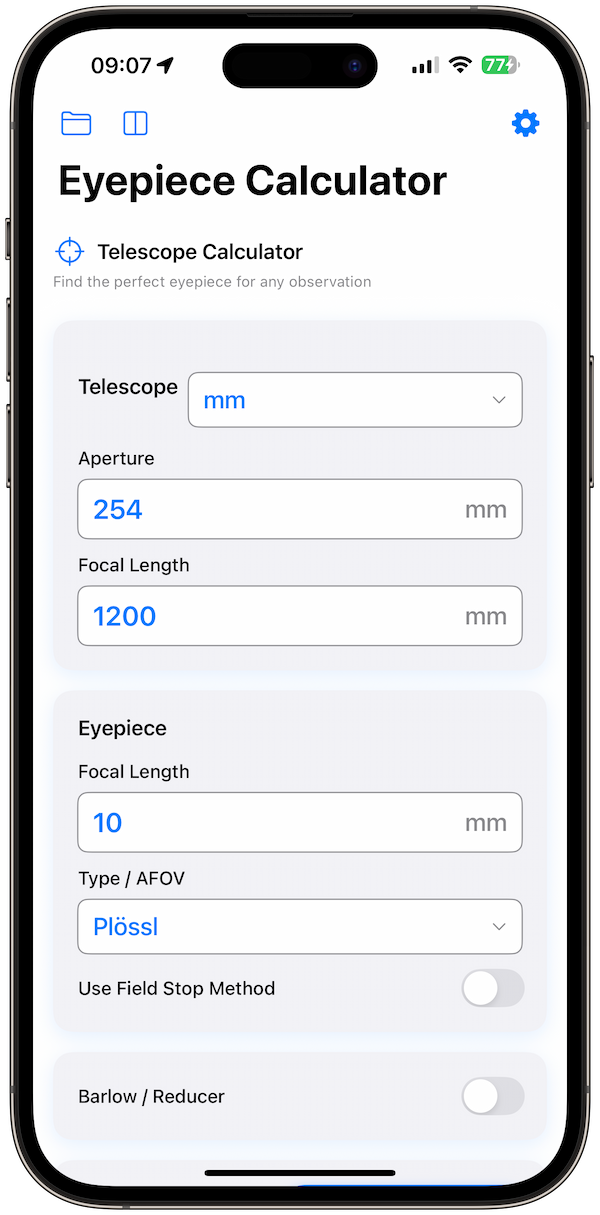
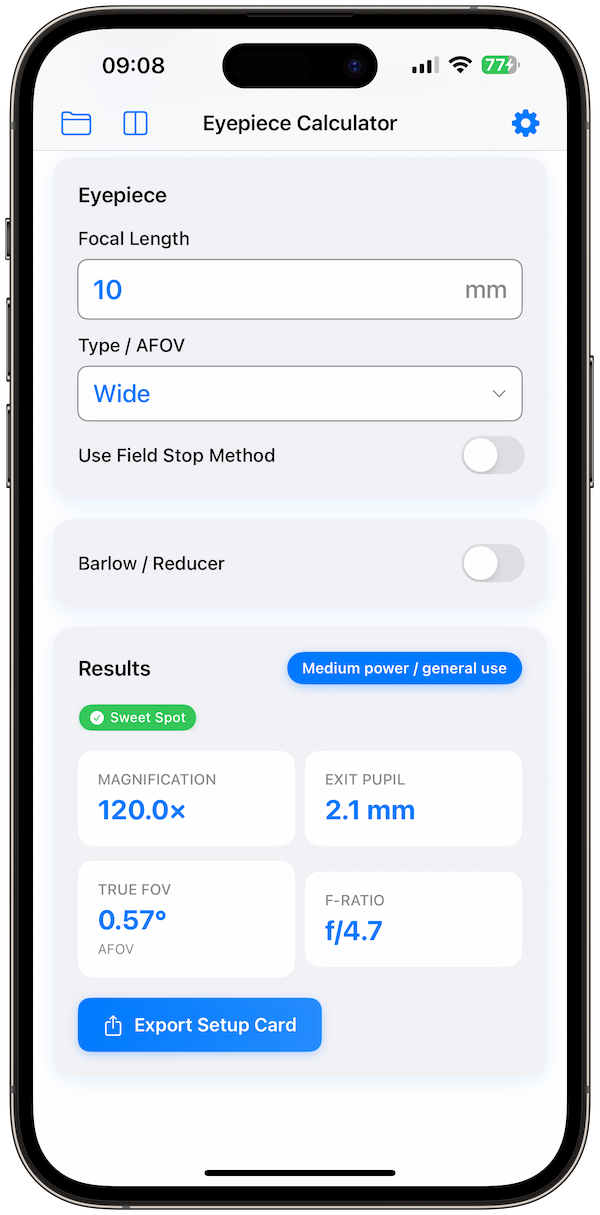
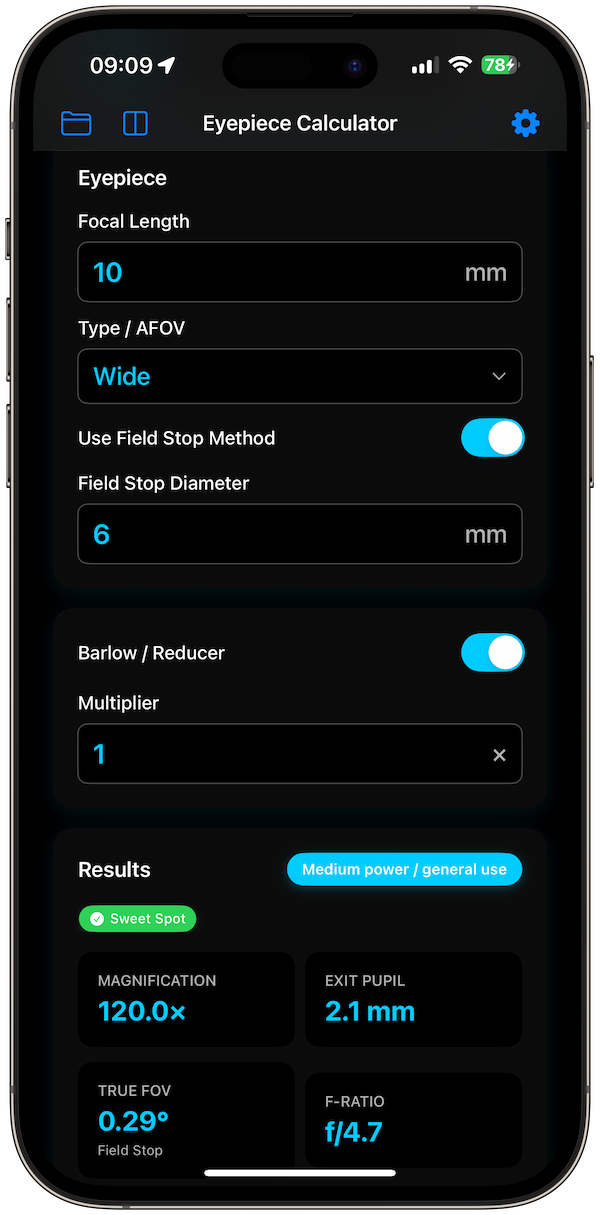
Managing these variables is tough. That's why Telescope Eyepiece Calculator includes a Seeing Slider in the Pro+ version.
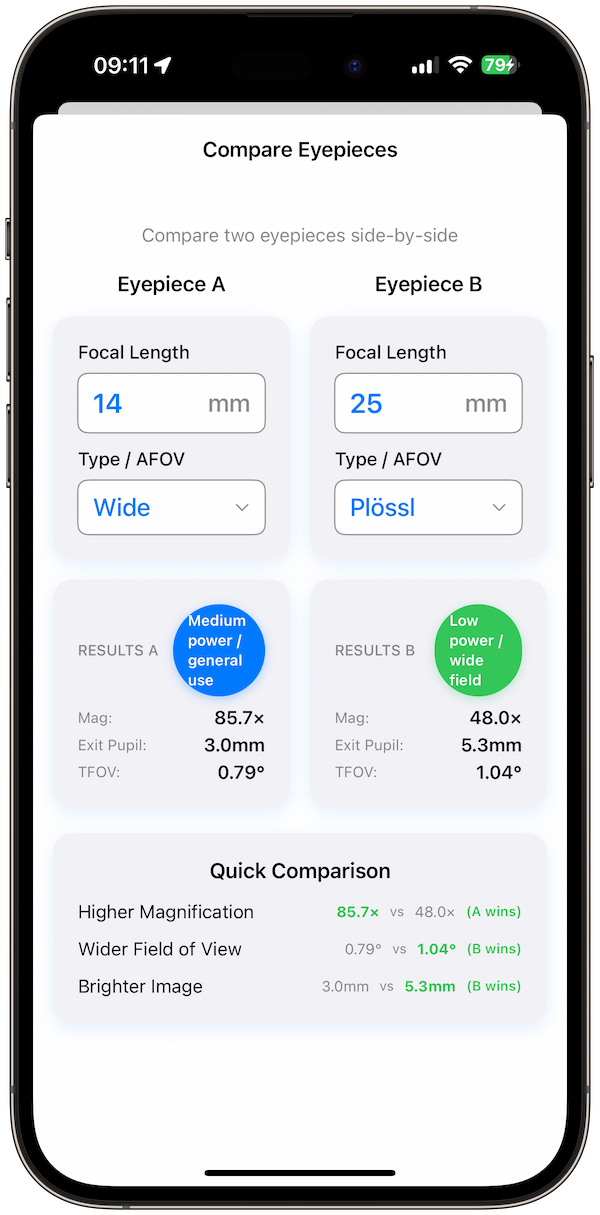
You enter the current condition (e.g., "Average Seeing"), and the app's Smart Hints adjust your maximum recommended magnification. It stops you from putting in a 3mm eyepiece on a night that only supports a 10mm.
/7 main calculator advanced calculations.png)
Live Weather Integration (Pro+)
Don't just guess. The Pro+ plan integrates with astronomy weather services to show you the forecast for tonight. It tells you:
- Cloud Cover: 0% (Clear)
- Seeing: Average
- Transparency: Excellent
This combo (Average Seeing + Excellent Transparency) means: "Skip the high-power planets. Go for low-power Galaxies." Knowing this saves your night.
Conclusion
The sky is not a static canvas. It's a living, breathing fluid. Learn to read it, plan around it, and let the app handle the math.
Master the Sky Conditions
Get live forecasts and seeing-adjusted recommendations with Pro+.
Download Telescope Eyepiece Calculator