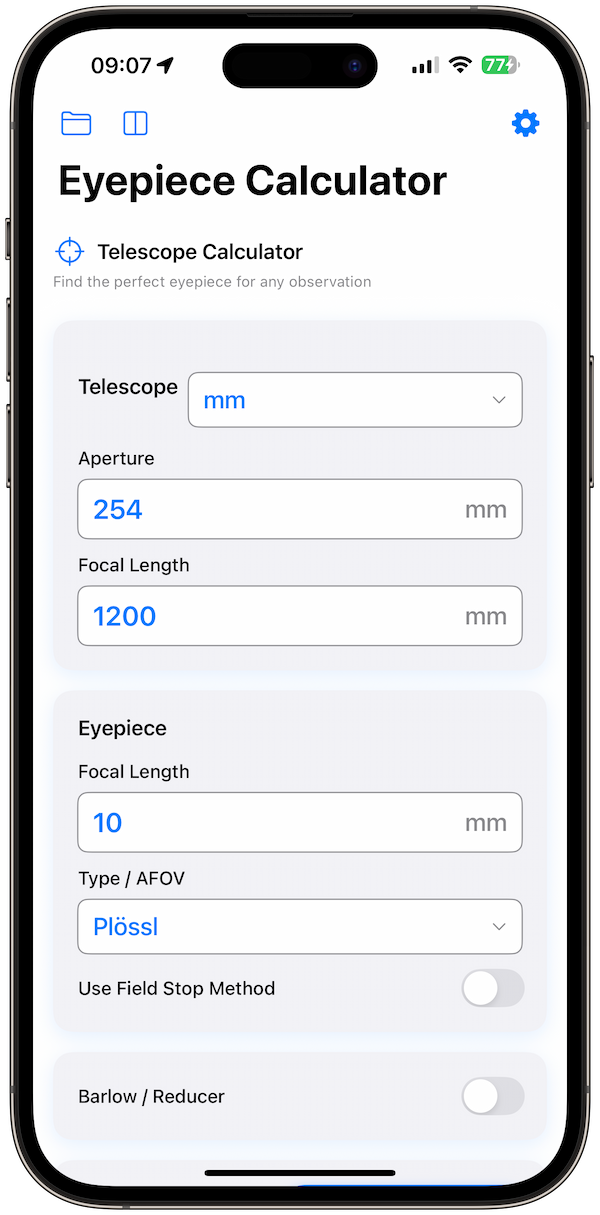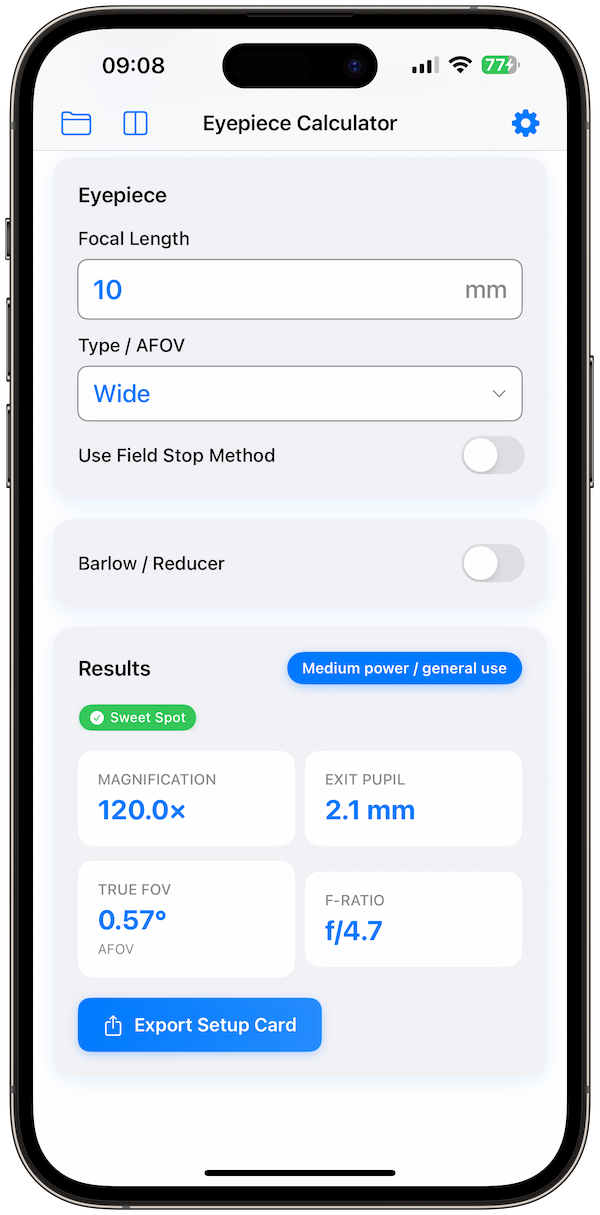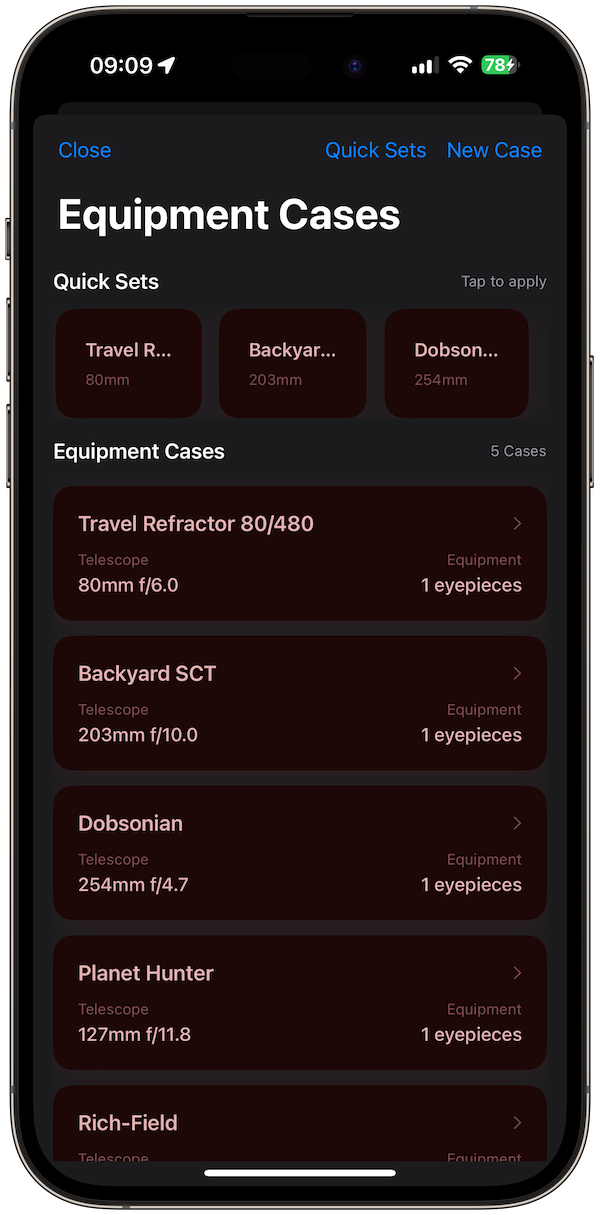
I still remember the night that pushed me to build this app. It was 2am, 20°F (-6°C), and I was standing in a field in rural Vermont. My fingers were numb, my red-light headlamp was dying, and I was trying to read a damp, laminated spreadsheet of eyepiece specifications. I just wanted to know one simple thing:
"If I put my 10mm eyepiece in with a 2x Barlow, will the Orion Nebula still fit in the view?"
The math isn't difficult—it's just division. But doing mental division at 2am while shivering is a recipe for frustration. That night, I realized that amateur astronomy didn't need another complex star chart app. It needed a dedicated, purpose-built tool for the "last mile" of observation: the connection between the glass and the eye.
This is the story behind the design of the Telescope Eyepiece Calculator, and how the new v1.2 update solves the biggest problems visual observers face.
The Challenge of "True" Night Mode
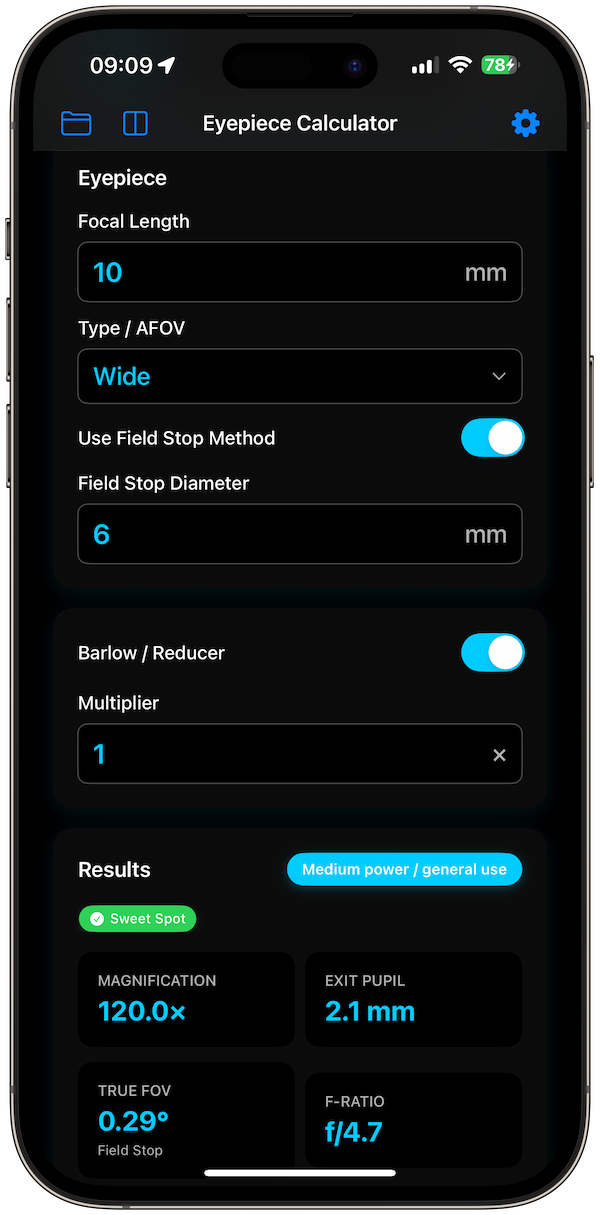
Every astronomy app claims to have a "Night Mode." Usually, this just means applying a red tint over the interface. But for the serious observer, that's not enough. Human night vision relies on rhodopsin (visual purple), a biological pigment that regenerates in darkness but is instantly destroyed by white or blue light.
When designing Telescope Eyepiece Calculator, we didn't just want a "dark theme." We needed a biologically safe interface.
The Red Spectrum Rule
Our interface strictly limits wavelengths. We avoid pure white (#FFFFFF) even in text, opting for high-contrast red variants that remain legible without triggering the photopic (daytime) vision response.
We spent weeks tweaking the contrast ratios. If the red is too dim, you squint (causing eye strain). If it's too bright, you lose night vision. The final design uses a specific shade of amber-red that maximizes readability while minimizing "bloom."
/3 Dark Mode.png)
Visualizing the Invisible: The v1.2 Simulator
For version 1.2, we wanted to tackle the next level of abstraction. Knowing that your True Field of View (TFOV) is "1.2 degrees" is useful data, but it's hard to feel. Is 1.2 degrees enough for the Double Cluster? Will the Veil Nebula spill out?
We built the Visual Target Simulator to bridge this gap. The engineering challenge here was scale.
The Scale Problem
Jupiter varies in size from 30 to 50 arcseconds. The Andromeda Galaxy is 180 arcminutes (3 degrees). That's a 360x difference in scale! displaying these on the same phone screen required a dynamic rendering engine that zooms seamlessly from "Planetary Mode" to "Wide Field Mode" without losing context.
The result is a fluid experience where you can verify your planetary eyepiece (6mm) and your wide-field sweeper (30mm) in seconds.
/1 main calculator screen.png)
The "Eyepiece Battle" Engine
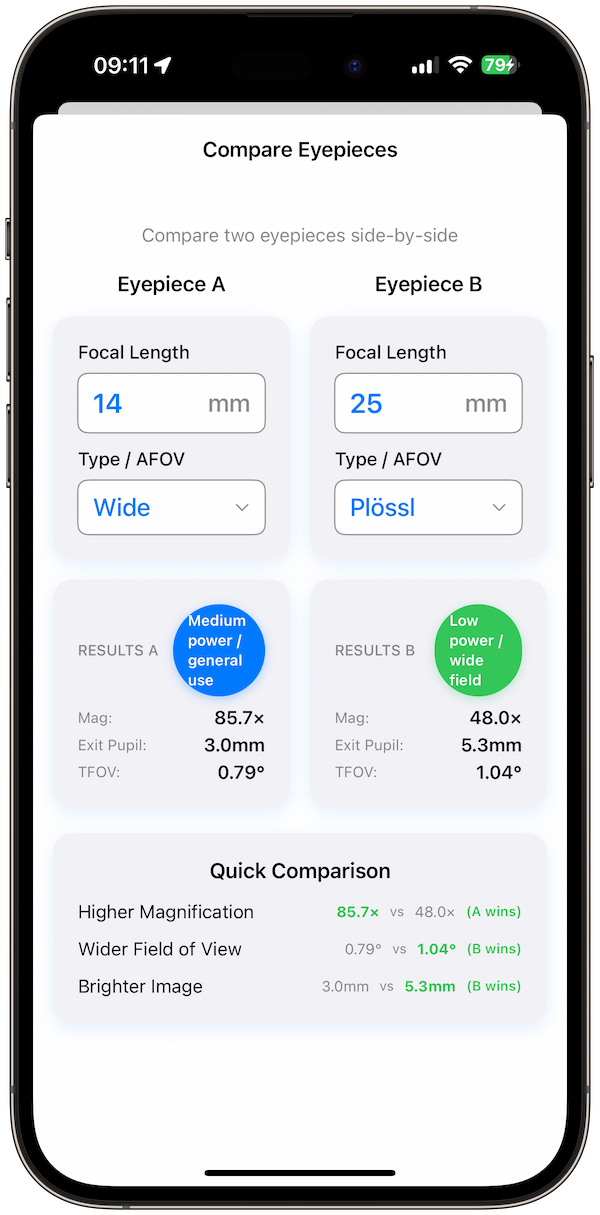
One of the most requested features was comparison. Astronomers love to debate "Nagler 31mm vs Panoptic 41mm." I found myself constantly switching back and forth between calculations to compare them.
The new Eyepiece Comparison Tool allows you to lock two configurations side-by-side. But we went further with the "FOV Overlay" mode. By rendering the two circles concentrically, you don't just see the numbers difference—you see the sky difference.
/5 compare eyepieces FOV overlay.png)
Design Constraints: The Apple Watch App
Bringing this tool to the Apple Watch was an exercise in extreme minimalism. You don't want to type on a watch in the dark. We designed the Watch app as a "Read Only" companion that syncs with your phone.
When you are at the eyepiece, your hands are busy focusing or nudging the scope. You can simply glance at your wrist to recall:
- "What magnification is this again?"
- "What's my Exit Pupil? (Is my eye wasting light?)"
We stripped away everything else. No settings, no adding gear. Just the critical data, optimized for the OLED black levels of the Watch to preserve battery and night vision.
Privacy as a Feature
Finally, a core design principle of Telescope Eyepiece Calculator is "Offline First." The best dark sites—remote deserts, mountains, national parks—often have zero cell service. A cloud-based app is useless there.
That's why our entire database of 300+ eyepieces and all calculation logic lives locally on your device. We don't track your location, we don't upload your equipment list, and we don't show ads. Your observing session is private, peaceful, and uninterrupted.
The Verdict
Astronomy is a pursuit of patience and precision. Your tools should honor that. We built Telescope Eyepiece Calculator not to replace the experience of observing, but to remove the friction that gets in the way of it.
Upgrade Your Observing Toolkit
Join thousands of astronomers who use Telescope Eyepiece Calculator to plan their nights and choose the perfect glass.