Walk into any department store and look at the telescope boxes. You'll see bold claims: "450x Power!", "675x Magnification!"
These numbers are technically true (math-wise) but practically useless. It's like a car speedometer that goes to 300mph—the engine will explode before you get there. In astronomy, ""empty magnification"" is the silent killer of good views.
In this guide, we'll bust the high-power myth, explain exactly how to find your telescope's actual useful limit, and show you why ""less is often more.""
The Golden Rules of Magnification
There are two hard limits to how much you can zoom in. One is set by physics (your telescope), and one is set by the atmosphere (the sky).
Rule 1: The Aperture Limit
You can typically use 50x per inch (or 2x per mm) of aperture.
- 60mm (2.4") Refractor Max ~120x
- 8" (200mm) Dobsonian Max ~400x
- 14" (350mm) SCT Max ~700x
Rule 2: The Atmosphere Limit
Regardless of how big your scope is, the atmosphere is a turbulent ocean of air. On most nights, the sky limits you to 200x - 250x.
Pushing past this just magnifies the blur.
The Invisible Villain: Exit Pupil
There's another factor that ruins high-power views: Exit Pupil. This is the beam of light leaving the eyepiece and entering your eye.
As you increase magnification, the exit pupil gets smaller. If it gets too small (below 0.5mm), the image becomes incredibly dim, and you start seeing ""floaters"" (little squiggles) in your own eye. It's like trying to look through a pinhole.
Testing Your Limits in the App
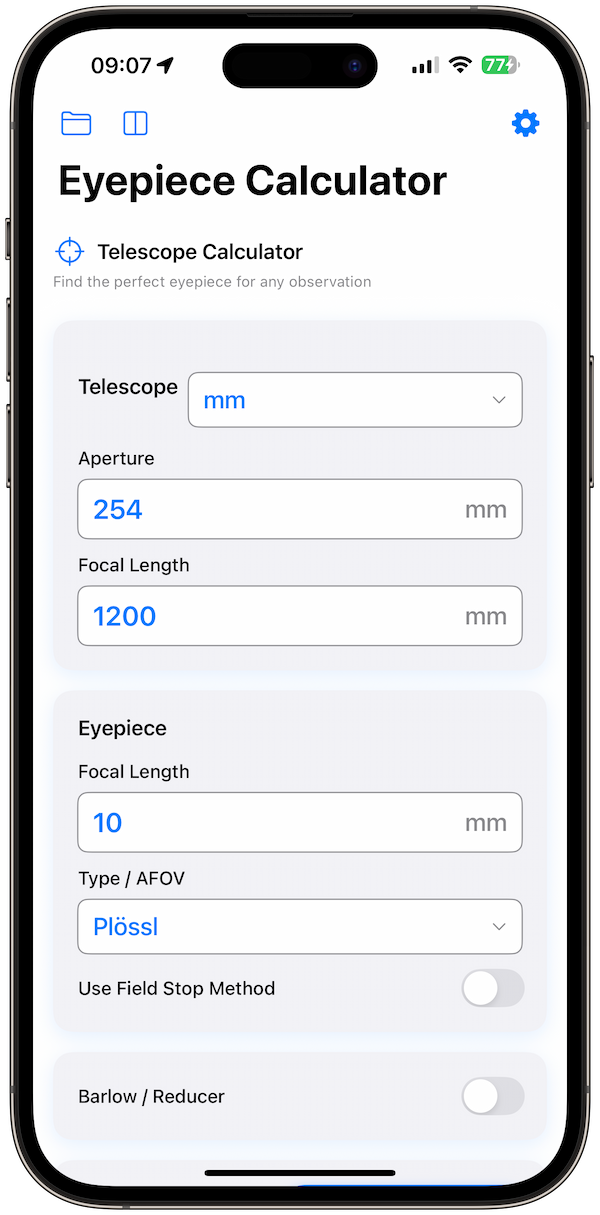
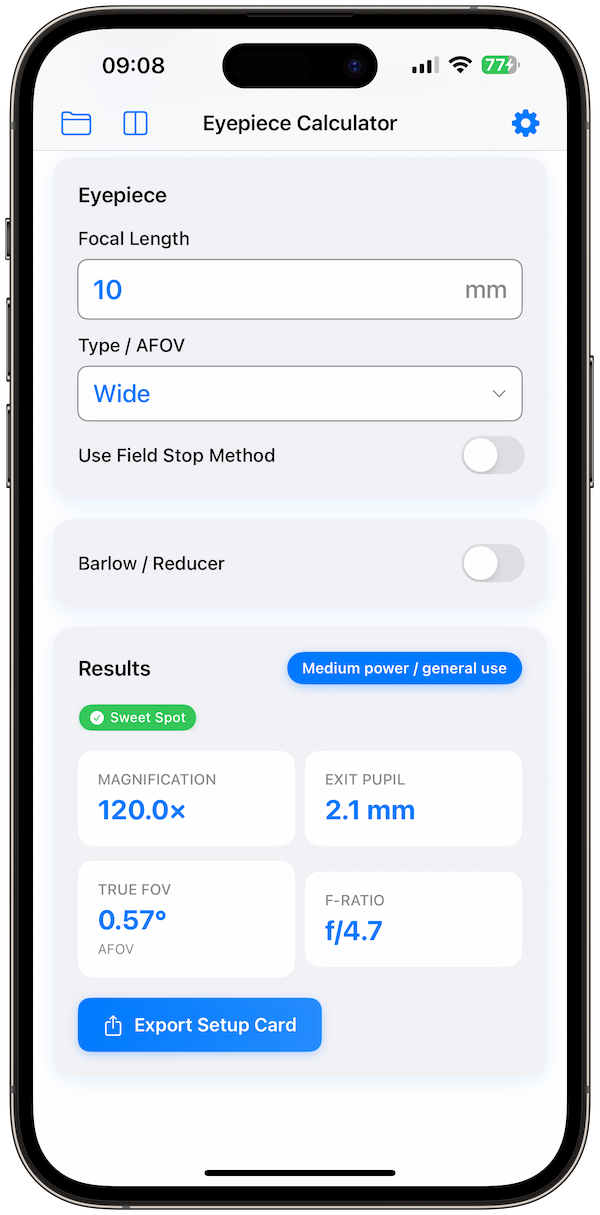
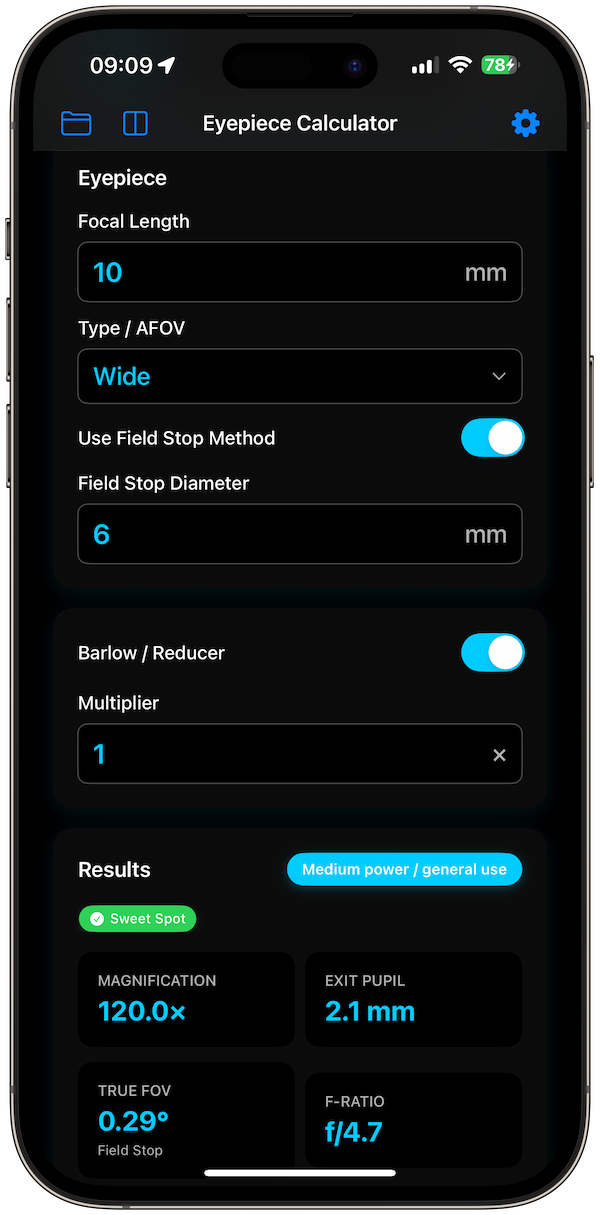
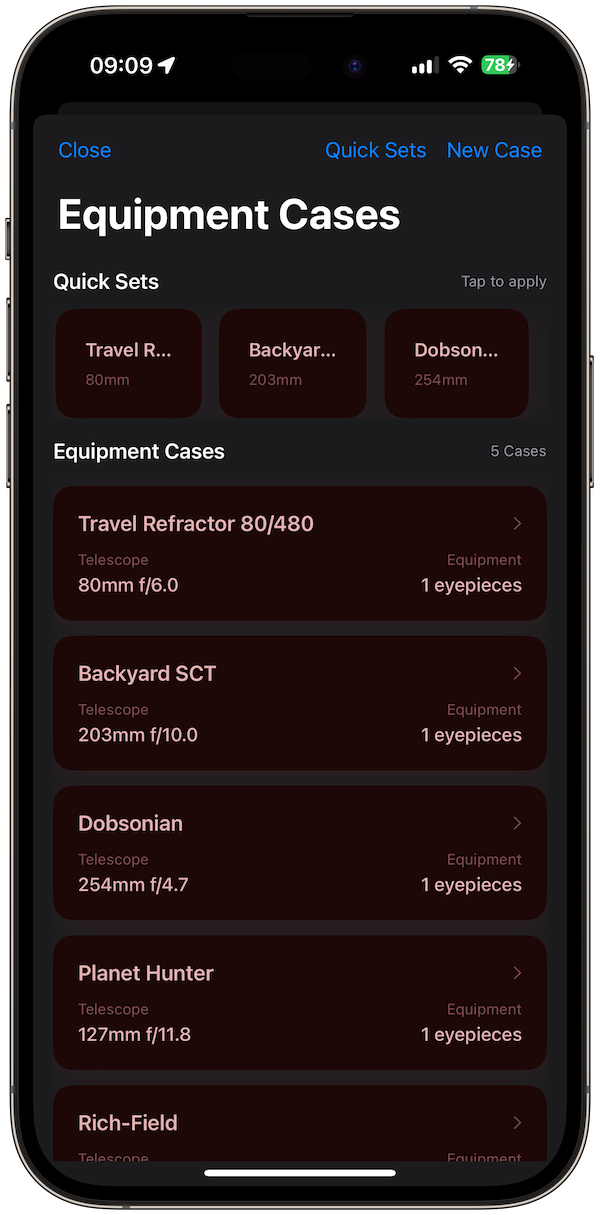
You don't need to memorize these math rules. Telescope Eyepiece Calculator has these safety limits built-in.
When you enter an eyepiece that pushes your telescope too far, the app's Smart Hints turn red:
/7 main calculator advanced calculations.png)
The "Floaters" Warning
If your Exit Pupil drops below 0.5mm, the app warns you. This saves you from buying a 3mm eyepiece that you'll struggle to use.
Example: The "Too Much" Test
Let's look at a common mistake setup:
- Telescope: 130mm Newtonian (Focal Length 650mm)
- Eyepiece: 4mm Plössl
- Barlow: 3x
The Math:
Magnification = (650 / 4) * 3 = 487x
The Reality:
Your 130mm scope has a theoretical max of ~260x. At 487x, you are nearly double the limit. The image will be a dark, fuzzy blob. The Exit Pupil is a microscopic 0.2mm. Use the Calculator app to separate the ""possible"" from the ""usable.""
Conclusion
Magnification is a tool, not a high score. The best view of Saturn is often at 150x or 200x, where the image is crisp and bright, not at 400x where it's a wobbly mess.
Check Your Limits Instantly
Download Telescope Eyepiece Calculator and see if your dream eyepiece is actually a nightmare.
Check My Magnification