True Field of View (TFOV) determines how much of the sky you can see through your telescope eyepiece. It's crucial for finding objects, enjoying wide-field views, and planning your observing sessions. Get it wrong and you'll struggle to locate objects or miss the context that makes deep sky objects beautiful.
This guide explains how to calculate true field of view with real examples, shows you how different eyepieces affect your view, and demonstrates how Telescope Eyepiece Calculator Pro handles these calculations automatically.
Understanding True Field of View
True Field of View is the actual angular size of the sky visible through your eyepiece, measured in degrees. It's different from apparent field of view (AFOV), which is a property of the eyepiece itself.
Key Concepts
- True Field of View (TFOV): Actual sky area you can see
- Apparent Field of View (AFOV): How wide the eyepiece "feels"
- Magnification effect: Higher magnification = smaller TFOV
- Eyepiece design: Different eyepiece types have different AFOV
The True Field of View Formula
The formula for calculating true field of view is:
TFOV = Eyepiece AFOV ÷ Magnification
This shows how magnification directly affects how much sky you can see.
Example 1: Standard Plössl Eyepiece
Let's calculate TFOV for a common eyepiece setup:
- Eyepiece: 25 mm Plössl (50° AFOV)
- Magnification: 40×
Step-by-Step Calculation
Step 1: Identify the values
Eyepiece AFOV = 50°
Magnification = 40×
Step 2: Apply the formula
TFOV = 50° ÷ 40 = 1.25°
Result: You can see 1.25° of sky - about 2.5 full moons side by side
Example 2: Wide Angle Eyepiece
Using a wide angle eyepiece with the same magnification:
- Eyepiece: 25 mm Wide Angle (68° AFOV)
- Magnification: 40×
Calculation Process
TFOV: 68° ÷ 40 = 1.7°
Result: 36% wider field than the Plössl - much better for finding objects
Example 3: Ultra Wide Angle Eyepiece
Using an ultra wide angle eyepiece:
- Eyepiece: 25 mm Ultra Wide (82° AFOV)
- Magnification: 40×
Calculation Process
TFOV: 82° ÷ 40 = 2.05°
Result: 64% wider field than the Plössl - excellent for wide field views
TFOV and Object Sizes
Understanding how TFOV relates to celestial object sizes helps you choose the right eyepiece for your targets.
Common Celestial Object Sizes
- Full Moon: 0.5° diameter
- Pleiades (M45): 1.2° across
- Andromeda Galaxy (M31): 3.2° × 1°
- Orion Nebula (M42): 1.3° across
- Double Cluster: 0.5° each
Optimal TFOV for Different Objects
- Large nebulae: 2-4° TFOV to see full extent
- Star clusters: 1-2° TFOV for context
- Galaxies: 0.5-1.5° TFOV depending on size
- Planetary nebulae: 0.2-0.5° TFOV for detail
Magnification vs. Field of View Trade-off
There's always a trade-off between magnification and field of view. Understanding this helps you choose the right eyepiece for each situation.
Example: Same Eyepiece, Different Magnifications
Using a 25 mm eyepiece (50° AFOV) with different telescopes:
- 1000 mm scope: 40× magnification, 1.25° TFOV
- 2000 mm scope: 80× magnification, 0.625° TFOV
- 4000 mm scope: 160× magnification, 0.31° TFOV
When to Use Different TFOV Ranges
- Finding objects: 2-4° TFOV for easy navigation
- General observing: 1-2° TFOV for balanced views
- High magnification: 0.5-1° TFOV for planetary detail
- Very high power: 0.2-0.5° TFOV for double stars
Eyepiece Types and Field of View
Different eyepiece designs offer different apparent field of view, directly affecting your true field of view.
Common Eyepiece AFOV Ranges
- Plössl: 50° AFOV - standard field
- Wide Angle: 60-70° AFOV - wider field
- Ultra Wide: 80-85° AFOV - very wide field
- Hyper Wide: 100°+ AFOV - extreme field
- Orthoscopic: 40-45° AFOV - narrow field
TFOV Comparison Example
All at 40× magnification:
- 25 mm Plössl: 1.25° TFOV
- 25 mm Wide: 1.7° TFOV
- 25 mm Ultra Wide: 2.05° TFOV
- 25 mm Hyper Wide: 2.5° TFOV
Common TFOV Mistakes
- Ignoring AFOV: Not considering eyepiece apparent field
- Too narrow field: Using high magnification for large objects
- Too wide field: Using low magnification for small objects
- Wrong eyepiece choice: Not matching TFOV to object size
How Telescope Eyepiece Calculator Pro Simplifies This
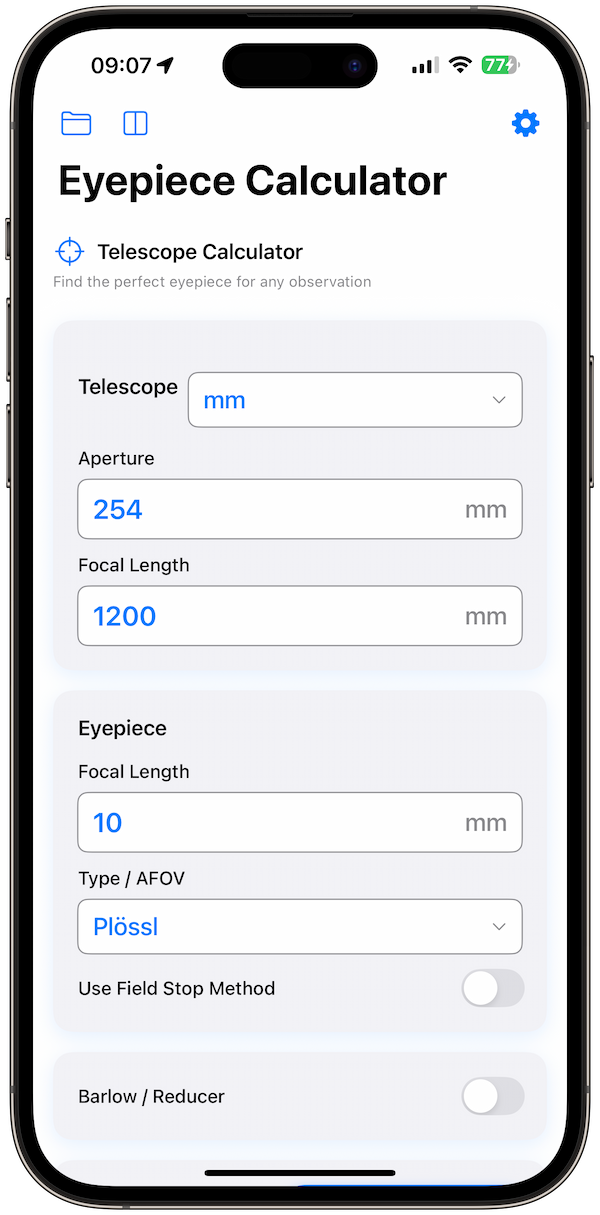
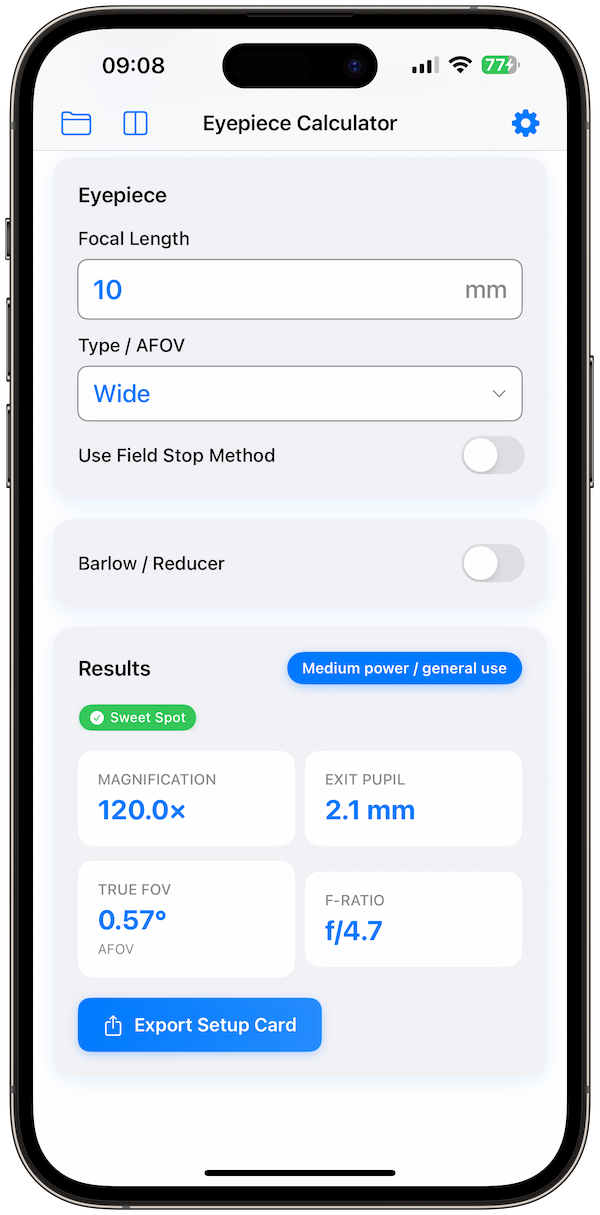
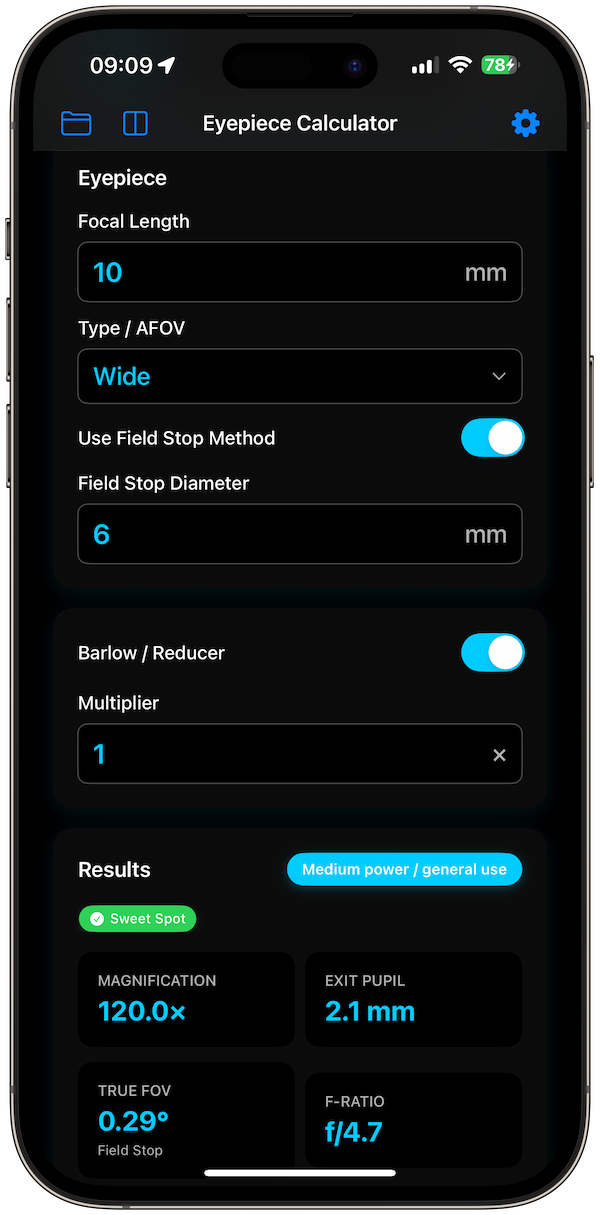
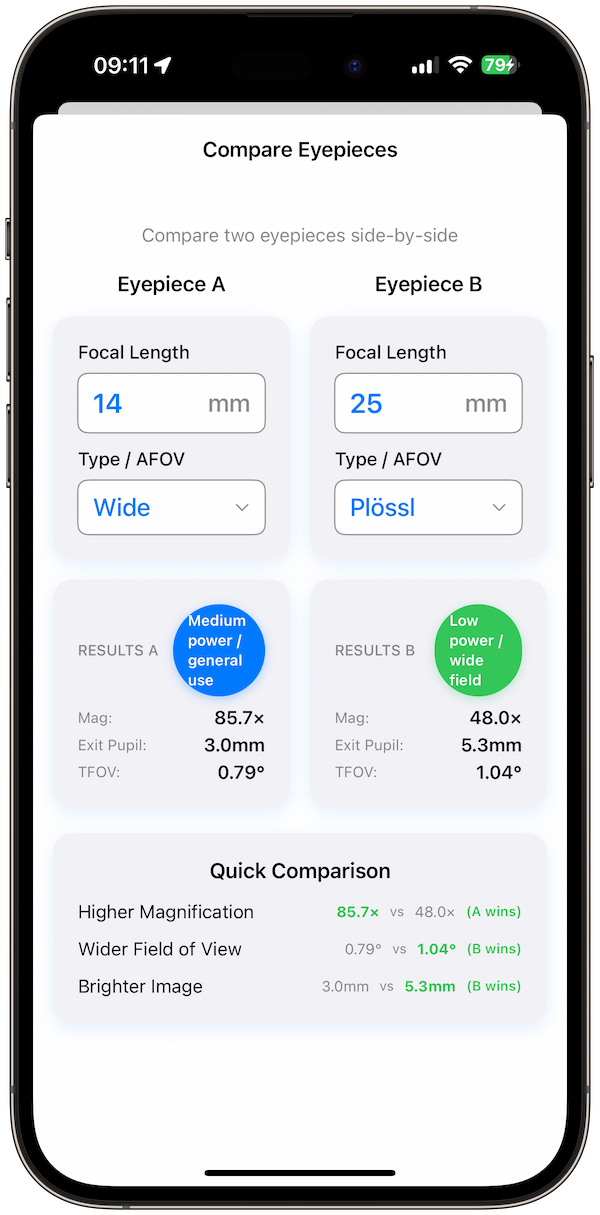
Telescope Eyepiece Calculator Pro calculates TFOV automatically:
- Live calculations: See TFOV as you adjust eyepiece focal length
- Eyepiece database: Built-in AFOV values for common eyepiece types
- Object size reference: Compare TFOV to common celestial objects
- Multiple setups: Compare different eyepieces side by side
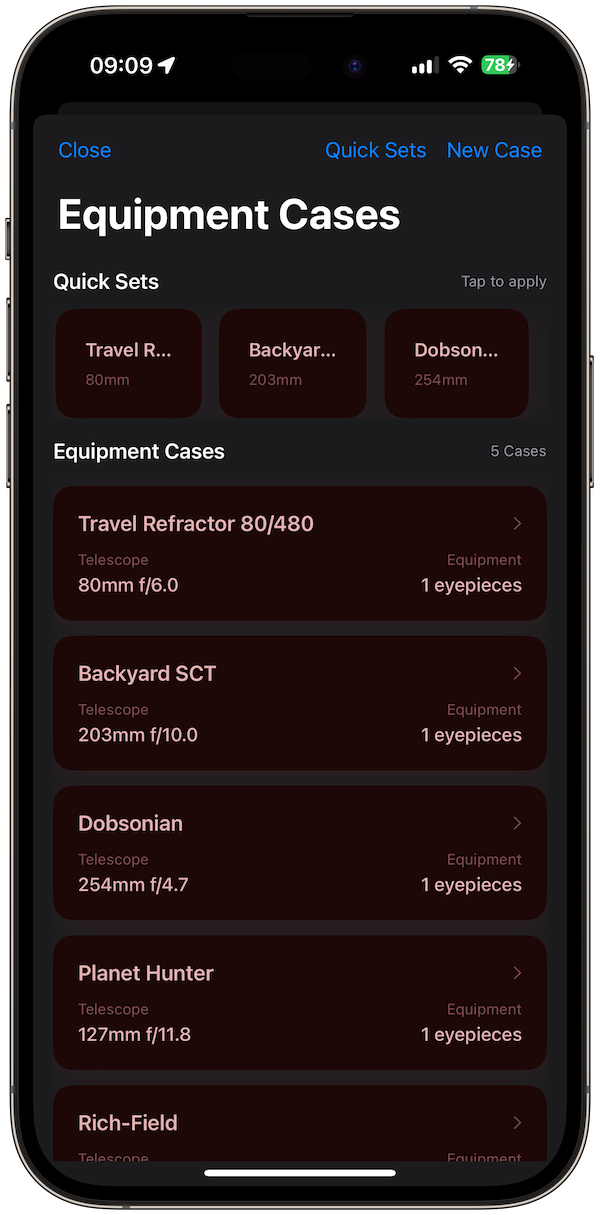
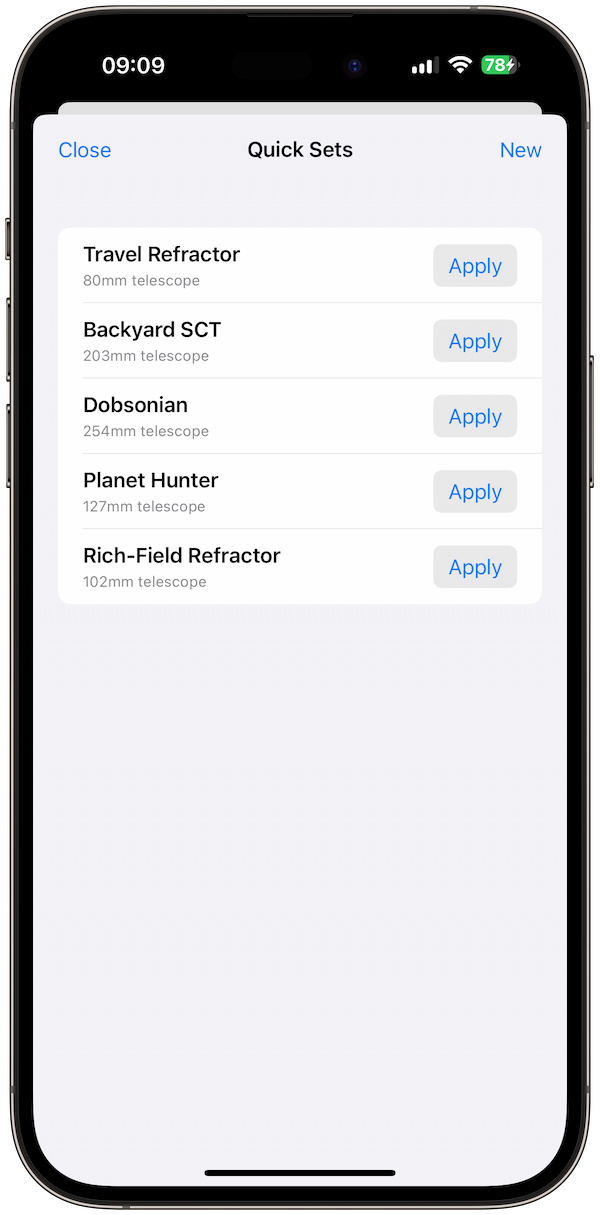
- Equipment cases: Save your favorite combinations
💡 Pro Tip: Use Telescope Eyepiece Calculator Pro's "Object Size Reference" to see how your TFOV compares to the Moon, Pleiades, and other common targets.
Professional Tips for TFOV Selection
- Start wide: Use low magnification to find objects, then increase
- Match to targets: Choose TFOV based on what you're observing
- Consider context: Sometimes seeing the surrounding area is important
- Plan your session: Have eyepieces ready for different TFOV ranges
TFOV and Observing Planning
Understanding TFOV helps you plan your observing sessions and choose the right equipment.
For Deep Sky Observing
- Target TFOV: 1-3° for most objects
- Eyepiece choice: Wide angle eyepieces for better views
- Finding objects: Start with 2-4° TFOV, then increase magnification
For Planetary Observing
- Target TFOV: 0.5-1° for good detail
- Eyepiece choice: High quality eyepieces for sharp images
- Magnification: Use high power for planetary detail
Final Thoughts
True Field of View is a crucial factor in telescope performance that directly affects your observing experience. By understanding how to calculate and optimize TFOV, you can get much better views and find objects more easily.
Ready to optimize your telescope setup? Download Telescope Eyepiece Calculator Pro and get instant TFOV calculations for any telescope and eyepiece combination.