Every astronomer remembers their first disappointment: buying a high-magnification eyepiece, pointing it at the Andromeda Galaxy, and seeing... nothing but a fuzzy gray blob. The problem wasn't the telescope, or the sky conditions, or even the user. The problem was Field of View (FOV).
Understanding Field of View is the single most critical skill for building an effective eyepiece collection. In this guide, we'll demystify the math, explain the crucial difference between a "drinking straw" view and a "spacewalk," and show you how to frame your favorite targets perfectly.
The Two Field of Views: AFOV vs TFOV
The most common confusion arises from the two types of "Field of View" printed on eyepiece boxes. They sound similar, but they measure completely different things.
1. Apparent Field of View (AFOV)
Definition: The angular diameter of the image circle you see when you hold the eyepiece up to your eye.
Think of AFOV as the size of the window you are looking through. It has nothing to do with the telescope; it is a property of the eyepiece design itself.
2. True Field of View (TFOV)
Definition: The actual patch of sky (measured in degrees) visible through the telescope.
This is the number that actually matters for observing. It determines whether you can fit the entire Pleiades cluster (1.8°) in your view.
The Math: Two Ways to Calculate
Most people know the basic formula, but pros use the "Field Stop" method for precision.
Method 1: The Approximation
TFOV = AFOV / Magnification
Method 2: The Field Stop (Pro Method)
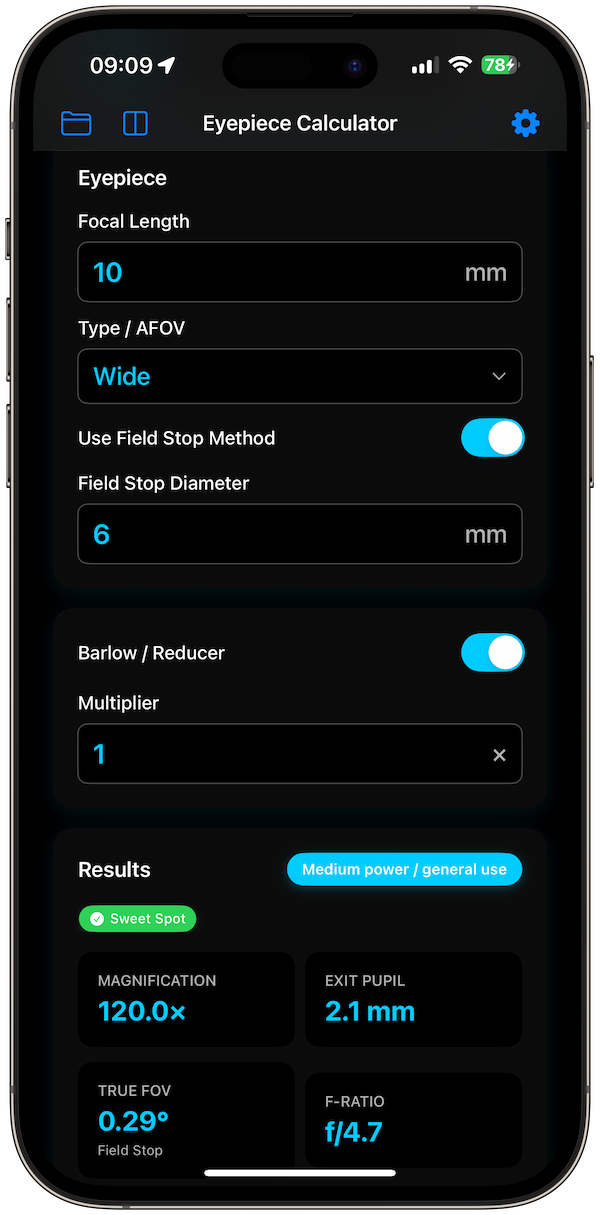
The "Field Stop" is the metal ring inside the eyepiece that defines the edge of the view.
TFOV = (Field Stop mm / Telescope Focal Length mm) × 57.3
Why use the Field Stop method? Because distortions in wide-angle eyepieces mean the basic formula is often off by 5-10%. The Field Stop method is exact.
The "Spacewalk" Effect
Why do astronomers pay $600 for a 100° eyepiece when a $50 Plössl offers the same magnification? It's all about immersion.
With a 100° eyepiece, you have to physically roll your eye to see the edge stop. It feels less like looking through a telescope and more like floating in space.
Visualizing TFOV with Overlay Rings
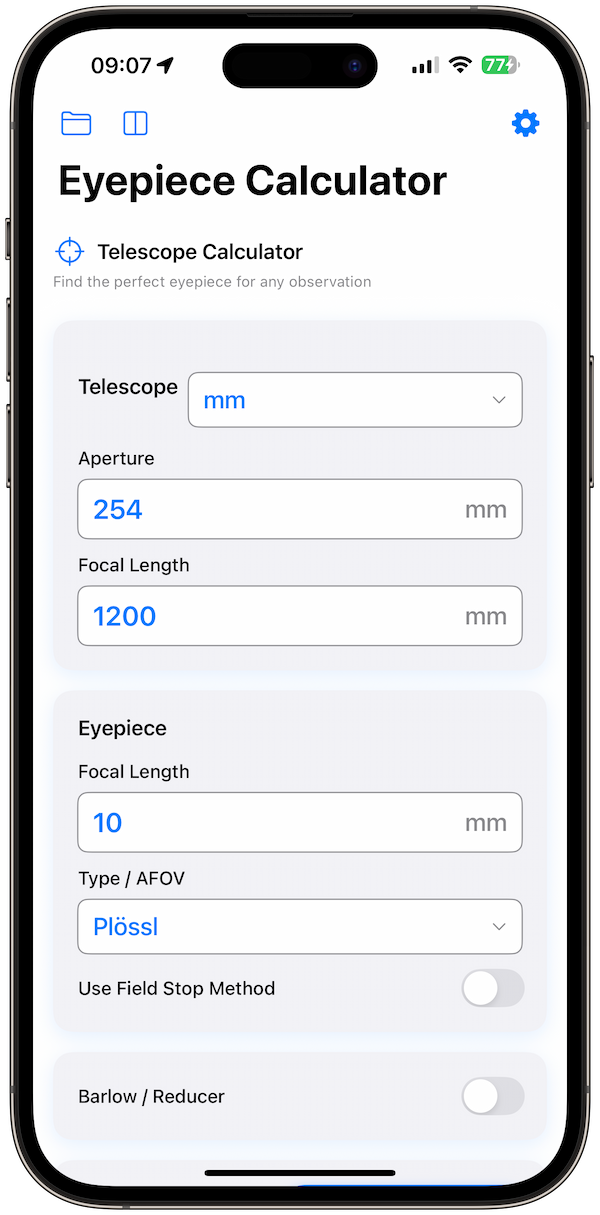
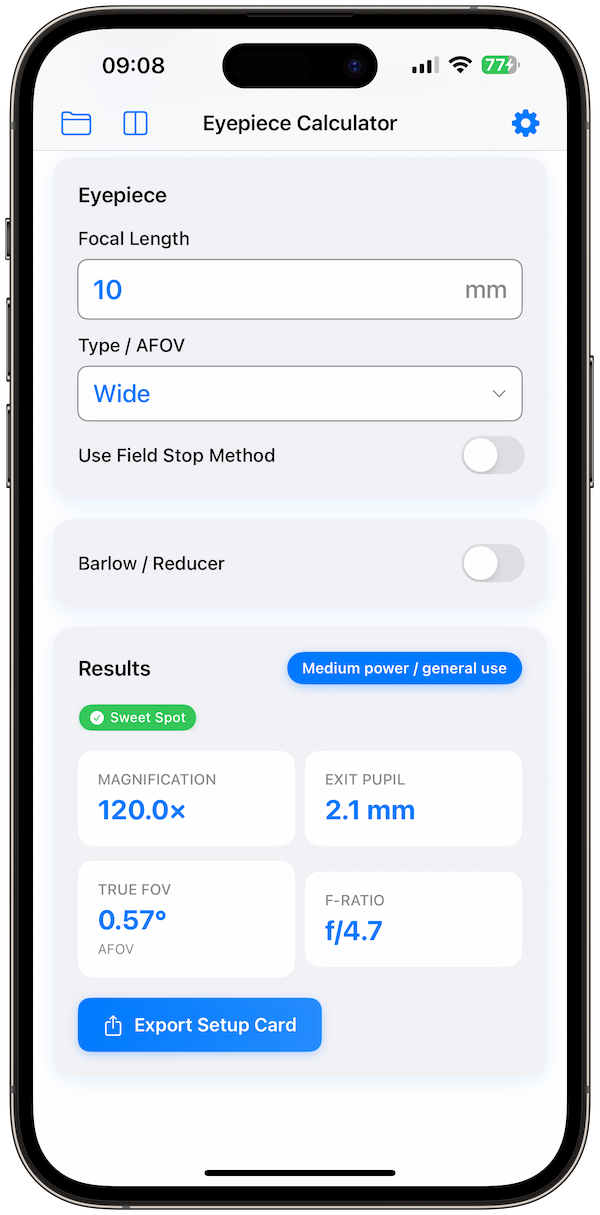
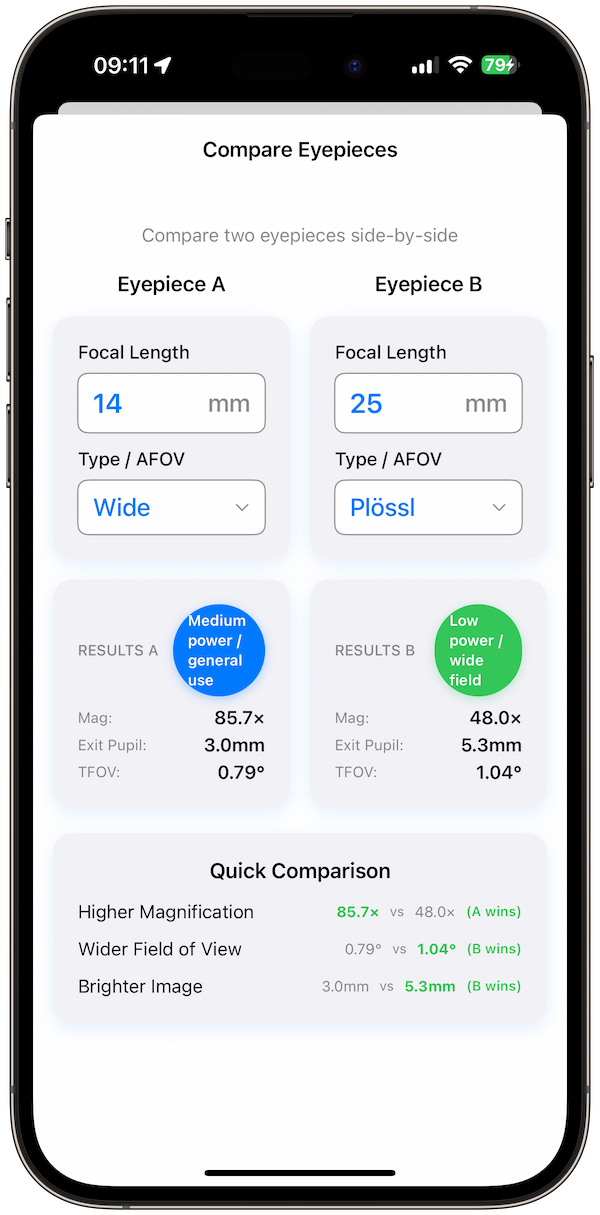
Numbers are abstract. Seeing is believing. The Telescope Eyepiece Calculator uses "Overlay Rings" to show you exactly how much sky you get.
/5 compare eyepieces FOV overlay.png)
Examples: Framing Famous Targets
Here is why TFOV matters for specific objects:
- The Pleiades (M45) Size: ~1.8°. Requires a low-power, wide-field eyepiece (e.g., 30mm, 70°). If your TFOV is 1.0°, you chop off the outer stars.
- Orion Nebula (M42) Size: ~1.0°. A 1.0° field frames it tightly, but a 1.5° field allows you to see the "Running Man" nebula nearby.
- Andromeda Galaxy (M31) Size: ~3.0°! Most telescopes can't fit the whole thing. You need a dedicated "Rich Field" refractor or a massive 2-inch wide-angle eyepiece to do it justice.
Conclusion
Don't rely on guesswork. Use the calculator to verify your TFOV before you head out under the stars.