The "Holy Grail" for many astronomers is a single setup that does it all: crisp visual views of Saturn and breathtaking long-exposure photos of the Orion Nebula.
While specialist gear is often better, many modern telescopes (like 80mm ED Refractors or 8" Schmidt-Cassegrains) are excellent hybrids. The challenge isn't the scope—it's the math. The requirements for your eye are vastly different from the requirements for a camera sensor.
The Great Divide: Eye vs. Sensor
To optimize for both, you need to understand three key differences.
1. Sensitivity & Time
The Eye: Works in "real-time" (milliseconds). It needs instant photons. It cannot "stack" light. This makes aperture king.
The Sensor: Can collect light for hours. It cares more about the "F-Ratio" (speed) and tracking accuracy than raw size.
2. Resolution (Sampling)
The Eye: Resolution is limited by atmospheric seeing and your pupil. Exit pupil matters most.
The Sensor: Resolution is limited by pixel size (microns). "Arcseconds per pixel" matters most. If you map one star to one pixel, it looks square (undersampled). If you map it to 100 pixels, it's bloated (oversampled).
Optimizing for Visual
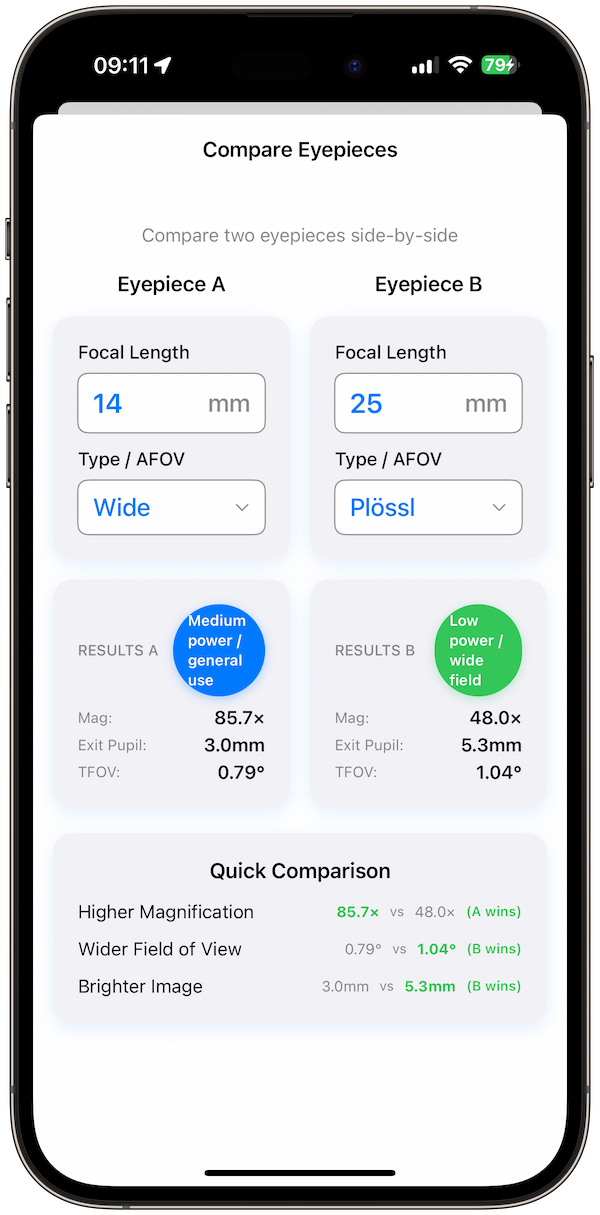
For visual use, you are balancing Magnification and True Field of View (TFOV). You want comfy eyepieces and a bright exit pupil.
Optimizing for Imaging
For imaging, you don't care about eyepieces. You care about the Field of View of the Sensor. A full-frame DSLR sees a huge chunk of sky. A tiny planetary camera sees a pinhole.
Instead of "Magnification," imagers use Image Scale (arcsec/pixel). You want to match this to your seeing conditions (usually 1.0 - 2.0 arcsec/pixel).
The Hybrid Workflow: Using One App
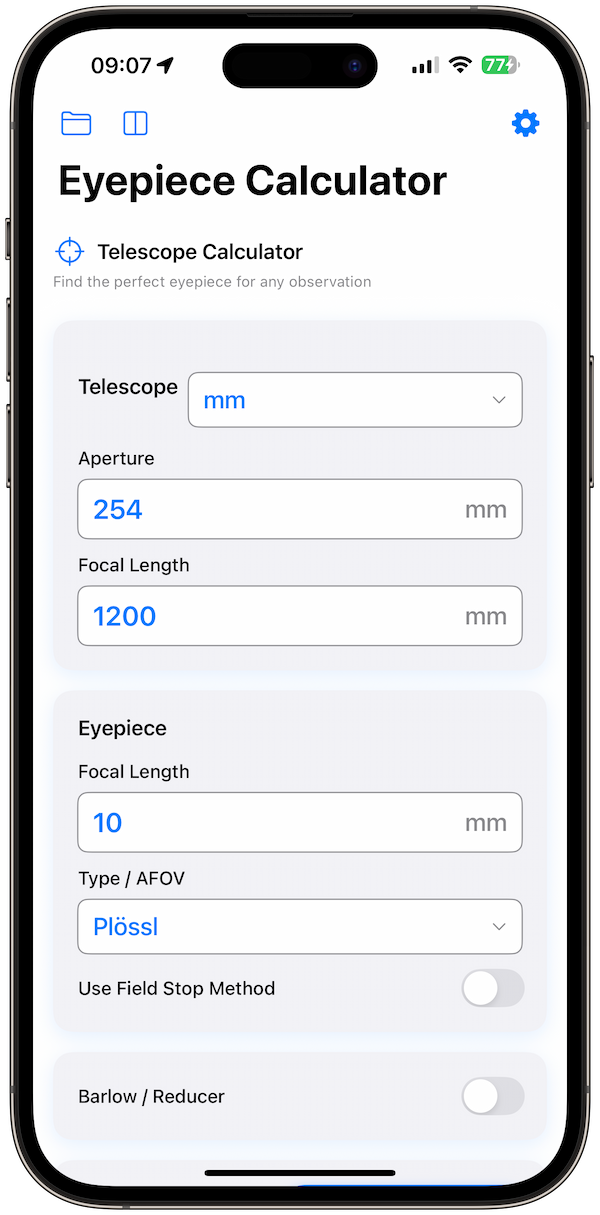
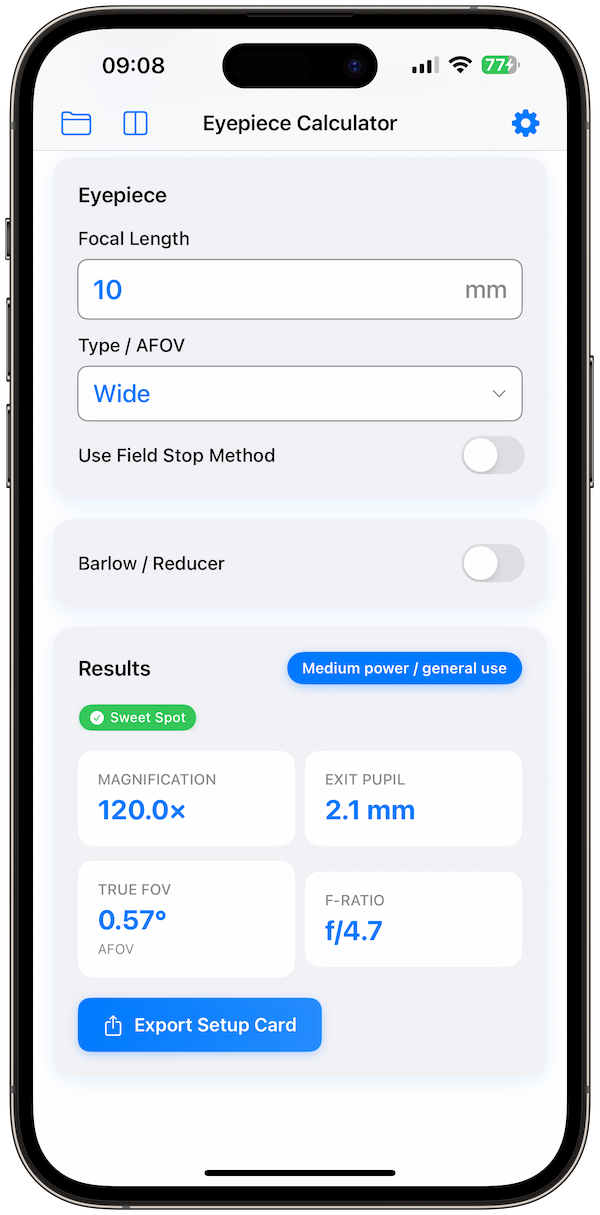
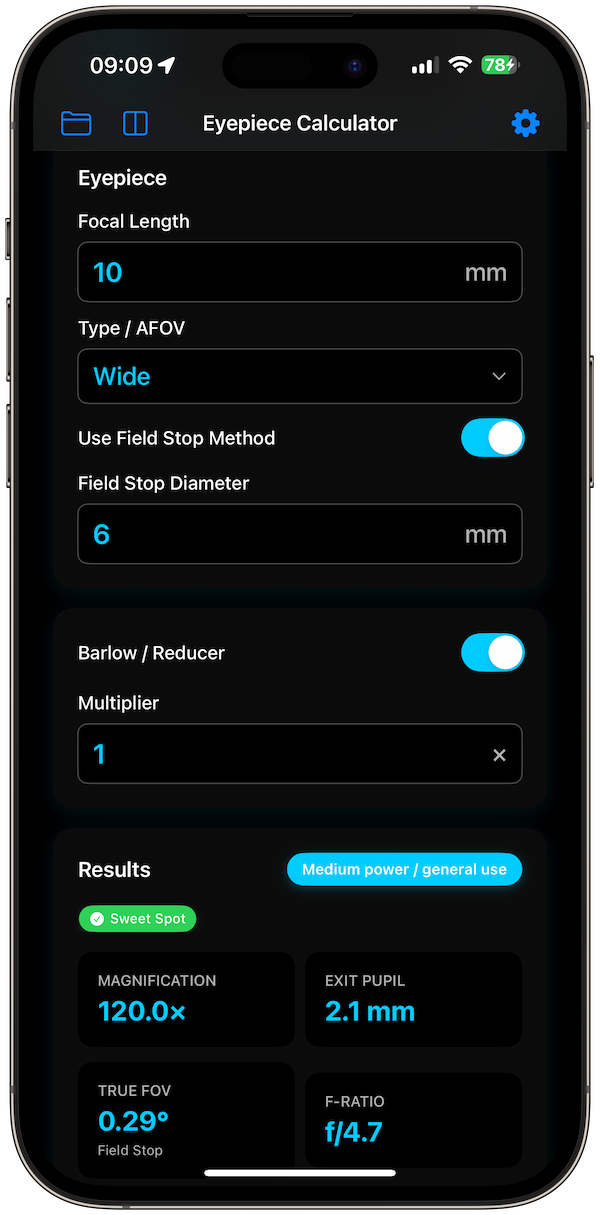
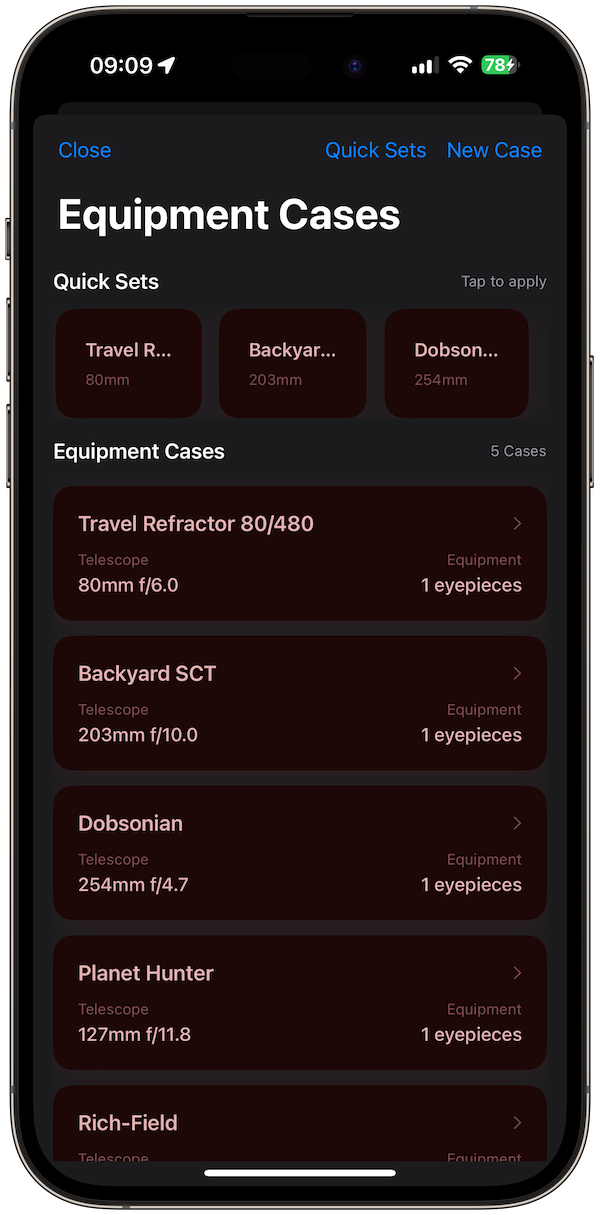
Managing these two worlds usually means using two different apps. But Telescope Eyepiece Calculator handles both.
/1 main calculator screen.png)
Visual Mode
Calculates Mag, Exit Pupil, TFOV
/6 cameras section.png)
Camera Mode
Calculates Resolution, Sensor FOV
Example: The 80mm "Do-It-All" Refractor
Let's look at a popular setup: A Sky-Watcher Evostar 72ED (420mm FL).
Visual Role: Wide Field Sweeper
Put in a 30mm eyepiece. You get 14x magnification and a massive 4.8° TFOV. You can fit the entire Andromeda Galaxy easily. It's a gorgeous portable scope.
Imaging Role: Nebula Hunter
Attach an APS-C DSLR (like a Canon T7). The sensor's FOV is 3.0° x 2.0°.
The specific resolution is 2.1 arcsec/pixel.
Verdict: This is perfectly sampled for average skies! It will take sharp, wide-field photos of the North America Nebula.
The Danger Zone
If you try to put a tiny planetary camera on this short scope, you will be deeply undersampled (blocky stars). The app warns you about this with its "Sampling Hints."
Conclusion
You don't need two telescopes to enjoy both hobbies. You just need to understand the math of each. Whether you are putting an eyepiece in the focuser or a camera sensor, use the Calculator to ensure your optics are optimized for the task.
Planning Visual or Imaging?
Switch modes instantly. Compare eyepieces and cameras side-by-side.
Get the Hybrid Planner